
Fourth of July Compliance Alert: Prepare Now, Respond Quickly, Document Everything
This is a long blog post - but an important one - and we urge all owners and managers to take the time to read it!
The Fourth of July should be one of the best weekends of the year for Newport Beach short-term rentals, our guests, and the local businesses that benefit from visitor spending. Most STR owners, managers, and guests want the same thing the City wants: a safe, enjoyable holiday weekend with responsible behavior and respect for neighbors.
But as the two recent permit suspension cases we have highlighted on the blog make clear, the bad actions of a few guests can create serious consequences for responsible owners and managers. A single incident can cost thousands of dollars. A suspension can cost tens of thousands of dollars in lost bookings. In the worst case, an owner can face the potential loss of the permit itself.
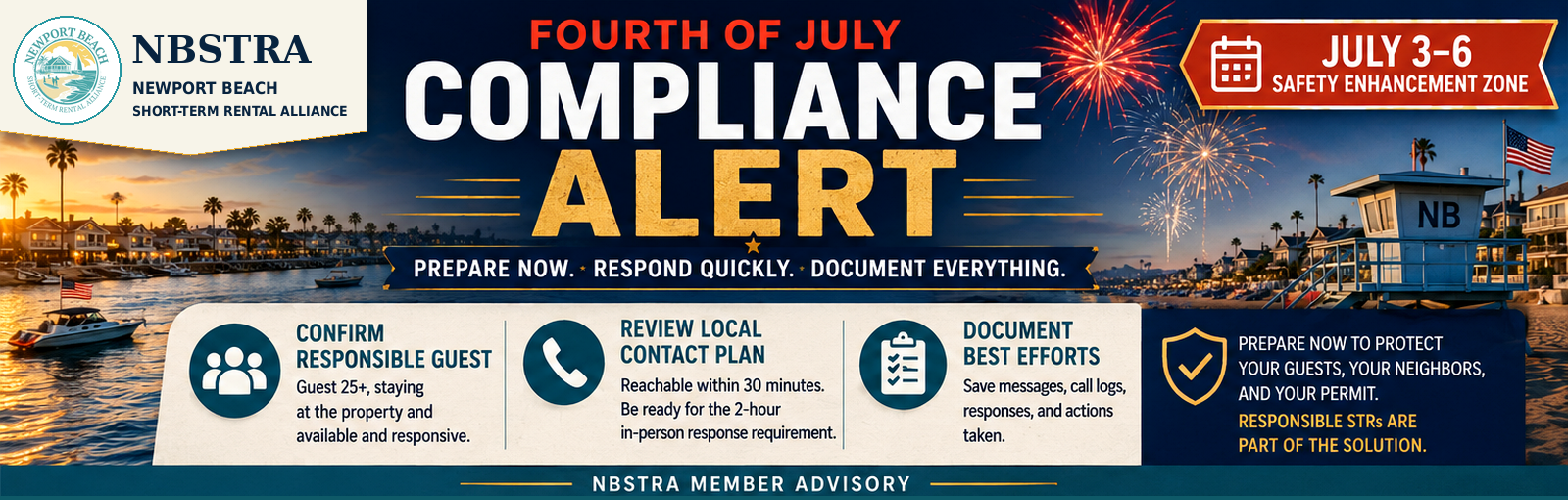
This year, the stakes are even higher. Earlier this year, the City expanded its Safety Enhancement Zone rules and adopted stronger short-term lodging enforcement provisions for high-risk periods, including the Fourth of July holiday. The City’s 2026 Fourth of July Safety Enhancement Zone period runs from July 3 through July 6.
At the same time, NBSTRA has submitted Public Records Act requests seeking the data needed to better understand whether STRs and their guests are actually the source of public safety problems during major holiday weekends, or whether responsible owners and managers are being held accountable for a broader set of visitor impacts.
While we await the City’s response to those PRA requests, members should not wait to prepare. Now is the time for heightened planning, heightened vigilance, and careful documentation.
Prepare Before Guests Arrive
Every owner and manager should review each Fourth of July reservation now, not after a problem occurs.
Confirm that your guest has received, acknowledged, and agreed to all applicable house rules, City rules, occupancy limits, parking rules, trash rules, noise restrictions, and the Good Neighbor Policy. Make sure the booking party understands that Newport Beach is not a place for house parties, loud gatherings, illegal fireworks, underage drinking, public drinking, drug use, or disorderly conduct.
Be especially clear about the rules most likely to create problems over the holiday weekend:
No loud or unreasonable noise.
No amplified or reproduced sound outside or audible from the property line during restricted hours.
No parties, large gatherings, or events.
No illegal fireworks.
No underage drinking or drug use.
No overcrowding.
No disorderly conduct.
No trash left out improperly.
No parking violations or blocked garages, driveways, alleys, or streets.
Do not assume that the guest read the fine print in a platform message. Send a direct, plain-language reminder before arrival. Ask for written acknowledgment. Save it.
Make Sure the Responsible Guest Is 25 or Older, Named, Available, and Responsive
The guest who signs the rental agreement matters.
Owners and managers should confirm that the adult transient user on the rental agreement is at least 25 years old, will actually be staying at the property, and will be available and responsive throughout the stay. This should not be treated as a paperwork requirement or a platform formality.
Before arrival, make sure the named responsible guest understands that they are the person you will contact if there is a complaint, City notice, noise issue, parking problem, trash issue, gathering, or other incident. They should be reachable by phone and text at all times during the stay, especially during the evening and overnight hours when most holiday weekend problems occur.
This is especially important under the City’s expanded rules. If a City official determines that a violation is occurring and provides the required notice, the adult transient user on the rental agreement who is 25 or older may be required to appear in person at the unit within two hours. If that person is not actually staying at the property, is unavailable, has turned off their phone, or has left the unit in the hands of younger guests, the owner or manager may be in a much worse position.
Owners and managers should consider sending a direct message before check-in that says, in substance:
“You are the responsible guest listed on the rental agreement. You must be at least 25 years old, you must be staying at the property, and you must be reachable by phone and text throughout the stay. If there is a complaint, City notice, or incident, you are expected to respond immediately and, if required, appear in person at the property.”
Save that message and the guest’s acknowledgment.
For Fourth of July reservations, do not rely on assumptions. Confirm the responsible guest’s cell phone number. Confirm they understand the rules. Confirm they understand the potential consequences. If the person who booked the property is not the person who will be staying there and taking responsibility for the group, address that before check-in.
Review Your Property Manager and Local Contact Plan
Newport Beach STR rules require a local contact person who can be reached 24 hours a day and respond to calls related to the unit within 30 minutes. Make sure the phone number is correct, the person is actually available, and the person knows what to do if there is a complaint, call from the City, call from the Police Department, neighbor complaint, platform alert, or direct guest problem.
For the Fourth of July weekend, “available” should mean more than technically reachable. The local contact should be ready to act quickly, keep records, go to the property if needed, and communicate with the owner or manager in real time.
If you use a property manager, check in with your property manager now. Do not assume they already have this covered. Ask who will be on call each night of the holiday period, how they will monitor complaints, who will respond if the City calls, and who is prepared to go to the property in person if required. Make sure they understand the two-hour in-person response requirement and the heightened risks during the Safety Enhancement Zone period.
If your property is self-managed, you need to be especially careful. Confirm that your local contact is truly available, nearby, and prepared to respond. If you are relying on yourself, consider whether you will actually be close enough to get to the property quickly if something happens. Holiday traffic in Newport Beach can be extremely difficult, especially on and around the Peninsula, Corona del Mar, Balboa Island, and other high-traffic areas of the City.
Do not assume you can get across town, onto the Peninsula, into Corona del Mar, or to another part of Newport Beach within two hours during the holiday weekend. If the City provides notice that triggers the in-person response requirement, traffic will not be a defense unless you can show you planned responsibly and made every reasonable effort to comply.
If you already have one violation on your record in the last 12 months, consider whether your normal response system is enough for this weekend.
This is the time to be extra careful.
Understand the Two-Hour In-Person Requirement
Under the City’s expanded rules, if a City law enforcement officer, fire official, code enforcement officer, or other authorized City official makes a good-faith determination that a violation is occurring at a short-term lodging unit and provides verbal notice to someone occupying the property and to the owner’s local contact, the owner or owner’s agent must appear in person at the unit within two hours. The adult transient user on the rental agreement who is 25 or older must also appear in person.
Members should treat that requirement seriously. If the City gives notice, do not debate whether the issue is minor. Do not wait for written paperwork. Do not assume the guest will handle it. Dispatch the owner, agent, or local contact immediately and document the time notice was received, who received it, who responded, when they left, when they arrived, and what they did.
This requirement is especially important in loud or unruly gathering situations, noise complaints, disorderly conduct situations, and other incidents that may involve City enforcement during the holiday period.
Know the New “Shall Revoke” Standard
Members should also understand that the City’s expanded rules do more than increase fines or create a longer suspension risk. For certain violations during high-risk periods, including the Fourth of July holiday period, the standard is now mandatory revocation.
In other words, for certain listed violations — including loud and unreasonable noise, large parties, loud or unruly gatherings, illegal fireworks, certain alcohol, drug, weapons, obstruction, interference, and other public safety-related offenses — the City’s ordinance says the short-term lodging permit shall be revoked if the violation is proven by a preponderance of the evidence and relates in any way to the permitted STR unit.
That is a very serious change. It means that even a first violation, if it falls within the listed categories during the holiday period, can put the permit itself at risk.
This is why preparation, fast response, and documentation are so important. Owners and managers should not assume that a clean record will protect them from the most serious consequences if a guest creates a major problem during the Fourth of July period. Your best protection is to prevent the problem if possible, respond immediately if it occurs, and preserve a clear record showing your best efforts at every step.
“Best Efforts” Means Action, Not Intentions
The City’s short-term lodging rules repeatedly use a “best efforts” standard. That matters.
“Best efforts” does not mean an owner can guarantee that a guest will never violate the rules. Owners and managers cannot control every action of every guest every minute of the day. But “best efforts” does mean you need to be able to show that you took meaningful, timely, reasonable steps to prevent problems and respond when problems occur.
That means sending rules in advance. Screening guests appropriately. Requiring written acknowledgment. Posting required information in the unit. Providing parking and trash instructions. Responding quickly to complaints. Contacting the guest immediately. Sending someone to the property when necessary. Escalating if the guest refuses to comply. Cooperating with City personnel. And documenting all of it.
In the two recent cases we highlighted, NBSTRA is concerned that the City appears to be treating “may suspend or revoke” language as if it means “shall suspend or revoke.” We will continue seeking records and answers on that issue.
But during the expanded Safety Enhancement Zone period, members should also understand that for certain listed violations, the City’s new ordinance does use mandatory “shall revoke” language. That makes preparation and documentation even more important.
If you are cited, appeal, lose the appeal, and later decide to seek judicial review, your best defense will be a clear record showing that you did everything a responsible owner or manager could reasonably do.
That record needs to be created in real time. Not reconstructed later.
Document Everything
Do not rely on memory. Do not assume a platform message will be easy to retrieve later. Do not assume the City will have all the facts.
Create a file for each Fourth of July reservation and save:
The rental agreement.
Proof that the named responsible guest is at least 25 years old.
Confirmation that the named responsible guest will be staying at the property.
The responsible guest’s cell phone number.
Written acknowledgment that the responsible guest will be available and responsive during the stay.
Guest acknowledgment of rules.
Pre-arrival messages.
House rules sent to the guest.
Parking instructions.
Trash instructions.
Good Neighbor Policy communications.
Local contact information provided to the guest.
Confirmation from your property manager identifying who is on call during the holiday period.
Written confirmation that your property manager or local contact understands the 30-minute response expectation and two-hour in-person response requirement.
The name and cell phone number of the person responsible for physically responding to the property.
Any backup local contact information.
Any neighbor complaints.
Any platform messages.
Any calls or texts with guests.
Any messages or call logs showing attempts to reach the responsible guest during an incident.
Any calls or texts with the local contact or property manager.
Call logs, texts, dispatch notes, or time-stamped records showing when the local contact or property manager was contacted and when they responded.
Any calls or contacts from City staff, Code Enforcement, Fire, or Police.
Time-stamped notes of what happened.
Photos or screenshots where appropriate and lawful.
Records showing when someone was dispatched and when they arrived.
A written summary after any incident.
If there is an incident, write down the sequence of events while it is still fresh. Who called? At what time? What was alleged? Who responded? What did the guest say? What did the local contact observe? What action was taken? Was the issue resolved? Were police or code enforcement still present? Was a citation issued? Was a notice posted? Were there witnesses?
The more serious the allegation, the more important the documentation.
If There Is a Complaint or Incident
If you receive a complaint, call, text, alert, or notice involving noise, a party, overcrowding, fireworks, parking, trash, alcohol, drugs, disorderly conduct, or any other public safety concern, respond immediately.
Contact the responsible guest by phone and in writing.
Tell the responsible guest exactly what must stop.
Dispatch the local contact, property manager, owner, or owner’s agent if the situation warrants it.
If the City has provided notice requiring an in-person response, send the owner or owner’s agent to the property within the required two-hour window.
Keep a written record of every step.
If the responsible guest does not answer, keep trying and document the attempts.
If the conduct continues, escalate.
If there is an emergency, call 911. If there is an ongoing disturbance, contact the appropriate City or Police non-emergency channel. If the guest is violating the rental agreement, consider whether stronger action is needed, consistent with the rental agreement and applicable law.
The key point is simple: do not be passive. A delayed or undocumented response can be used against you later, even if you acted responsibly in other ways.
Owners With a Prior Violation Should Be Especially Vigilant
If your property has one violation on its record within the last 12 months, you should treat this holiday weekend as especially high risk.
A second violation can put your permit in serious jeopardy. In some circumstances, a violation during the holiday period may also trigger the City’s mandatory revocation standard, even if it is a first violation. Even if you believe a citation is unfair, mistaken, or based on the conduct of guests you tried to control, you do not want to be in the position of having to prove that later with incomplete documentation.
For owners and managers with a prior violation, this is not the weekend to rely on routine procedures. Consider extra guest reminders, extra local monitoring, earlier check-ins, stronger written acknowledgments, and faster in-person response protocols.
Responsible STRs Should Be Part of the Solution
NBSTRA supports responsible ownership, responsible management, and respectful guest behavior. We also believe enforcement should be fair, evidence-based, and proportionate.
That is why we have submitted PRA requests seeking the underlying data on public safety impacts, STR-related incidents, citations, suspensions, and enforcement patterns. Members deserve to know whether STRs are truly the problem during major holiday weekends, or whether they are too often treated as a convenient scapegoat for broader holiday crowd impacts in Newport Beach.
But while that process continues, owners and managers need to protect themselves now.
The best outcome is a safe, successful Fourth of July weekend with no incidents, no citations, no suspensions, and no harm to the reputation of responsible STRs. The next-best outcome, if something does happen, is that every responsible owner and manager can show they prepared, responded quickly, used best efforts, and documented every step.
NBSTRA will continue monitoring the City’s enforcement approach, pursuing the data, and standing up for responsible short-term rental owners and managers in Newport Beach. In the meantime, please take the next several days to prepare carefully.
This is 4th of July is a great holiday, but is a weekend to be vigilant.