
Another Six-Month Permit Suspension Raises Questions About Proportionality
NBSTRA has reviewed another recent City of Newport Beach short-term rental permit suspension record. As with the prior case we discussed, we are not naming the permit holder here. The facts matter because they raise a serious question for every responsible STR owner and manager in Newport Beach: when the Municipal Code says the City may suspend or revoke a permit after two violations in twelve months, how is that discretion being used in practice? In short, is that “may” turning into shall?
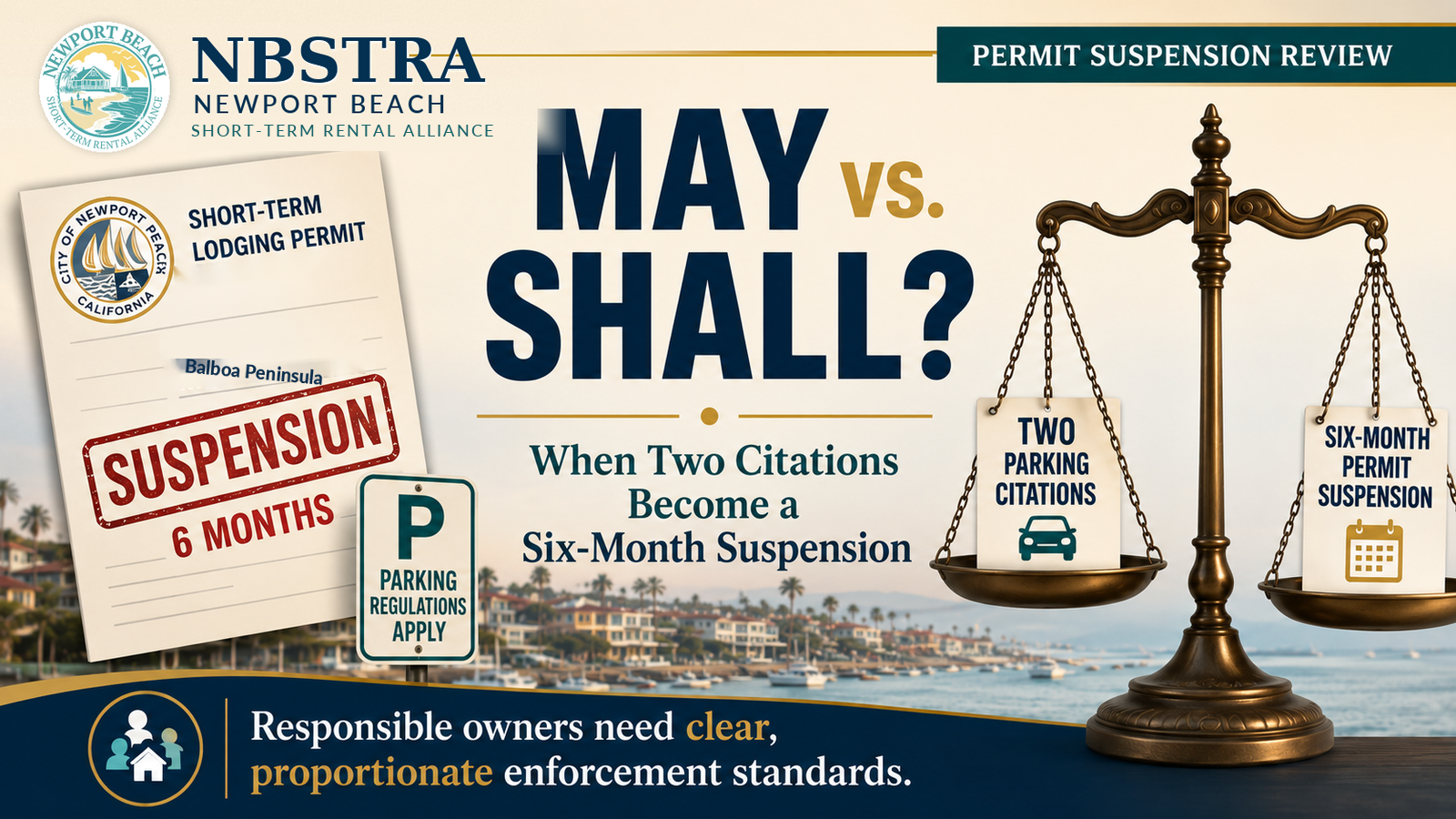
This case involved one unit at a multi-unit short-term rental property on the Balboa Peninsula. According to the City’s administrative record, guest vehicles received parking citations in July and again in August of 2025. The City then issued administrative citations to the short-term rental permit holder. Several months later, in February 2026, the City issued a Notice of Intent to Suspend the permit. After an administrative hearing, the City imposed a six-month suspension running from May through November 2026.
The practical effect was severe. The permit holder lost the ability to rent the unit during the summer and early fall, future bookings had to be canceled, advertising had to be removed, and the economic consequences were tens of thousands of dollars in lost income.
To be clear, the City did have a basis for taking the matter seriously. The record reflects two parking-related citations involving guest vehicles, and the City concluded that both were connected to the short-term rental unit. Newport Beach’s STR ordinance places responsibility on permit holders to ensure that guests comply with local parking laws. NBSTRA is not suggesting that the City should ignore real parking, access, or alley-clearance issues.
But the record also raises significant concerns about proportionality.
The underlying issue here was two parking tickets. This was not a record involving a loud party house, violence, repeated police calls, a large unruly gathering (LUGO), or an ongoing neighborhood nuisance. It appears to have been a disputed parking-space issue, with some serious ambiguity over whether the owner and guests had a good-faith basis to believe guests in that unit were allowed to park in the disputed area.
The permit record reflected a “designated” parking space for the unit. Guests had reason to believe they had been directed to park there. The owner argued that he had relied on property-boundary information supplied by the City and had tried to comply. Even if the City ultimately disagreed and concluded that the parking location encroached into the alley, this looks like the kind of issue that could have been addressed through a corrective compliance plan, revised parking instructions, removal of confusing markings, additional fines, or a stayed suspension triggered only by a future violation.
Instead, the result was a full six-month suspension.
Timing also matters. The actual parking incidents occurred in July and August 2025. The Notice of Intent to Suspend was issued in February 2026. The suspension was finalized in May 2026, landing directly in the high season. For an STR owner, a six-month suspension is not a minor administrative penalty. It can mean the loss of a major portion of annual rental income, forced cancellations for guests, financial disruption for owners and managers, and in some cases serious pressure on whether the owner can continue holding the property. This timing here closely mirrors that of the previous case we reviewed.
One case can be an anomaly. A second similar case begins to look like a pattern. Will our PRA request reveal a third (or even more) such incident?
All movie references aside, while we do not consider the City to be an enemy - far from it - NBSTRA has now reviewed at least two recent records where a six-month permit suspension was imposed on facts that, at minimum, appear open to reasonable dispute. In both cases, the suspension came months after the underlying violations. In both cases, the punishment appears far more severe than the immediate conduct at issue. And in both cases, the City’s use of suspension authority raises the same policy question: is Newport Beach treating “may suspend” as if it means “shall suspend” whenever two violations occur within a twelve-month period?
That question is one reason NBSTRA submitted a detailed Public Records Act request to the City this week. We are seeking data and records showing how often permit suspensions have been threatened or imposed, what types of violations have triggered suspension proceedings, how discretion has been exercised, and whether the City has considered lesser corrective measures before imposing the most economically damaging penalties.
We want the facts. We want to understand whether these cases are isolated examples or part of a broader enforcement approach.
In the meantime, NBSTRA members should take the warning seriously. It appears the City is treating any two qualifying violations within twelve months as permit-threatening. Owners and managers should not assume that a parking citation, trash issue, corrected noise complaint, or other citation will remain a minor matter.
Now is the time to review guest instructions, parking diagrams, house rules, local contact procedures, and internal response protocols. Make sure the parking directions given to guests match the permit conditions and the physical reality on the ground. Make sure guests know exactly where they can and cannot park. Make sure local contacts are reachable and responsive. And if you receive a citation that you believe is inaccurate or overstated, take it seriously immediately. If you already have one citation against your permit, expect that a second citation will likely results in a suspension or revocation.
NBSTRA supports fair enforcement against irresponsible operators. Responsible owners and managers have a direct interest in protecting public safety, preserving neighborhood quality of life, and maintaining Newport Beach as a well-managed vacation rental community.
But enforcement should also be proportionate. It should distinguish between serious behavior that threatens public safety and correctable compliance problems. A six-month permit suspension should not become the default response to any two violations, especially when the facts are ambiguous and the economic consequences are severe.
NBSTRA will continue pressing for transparency, proportionality, and clear standards so responsible short-term rental owners and managers know the rules and have a fair opportunity to comply.