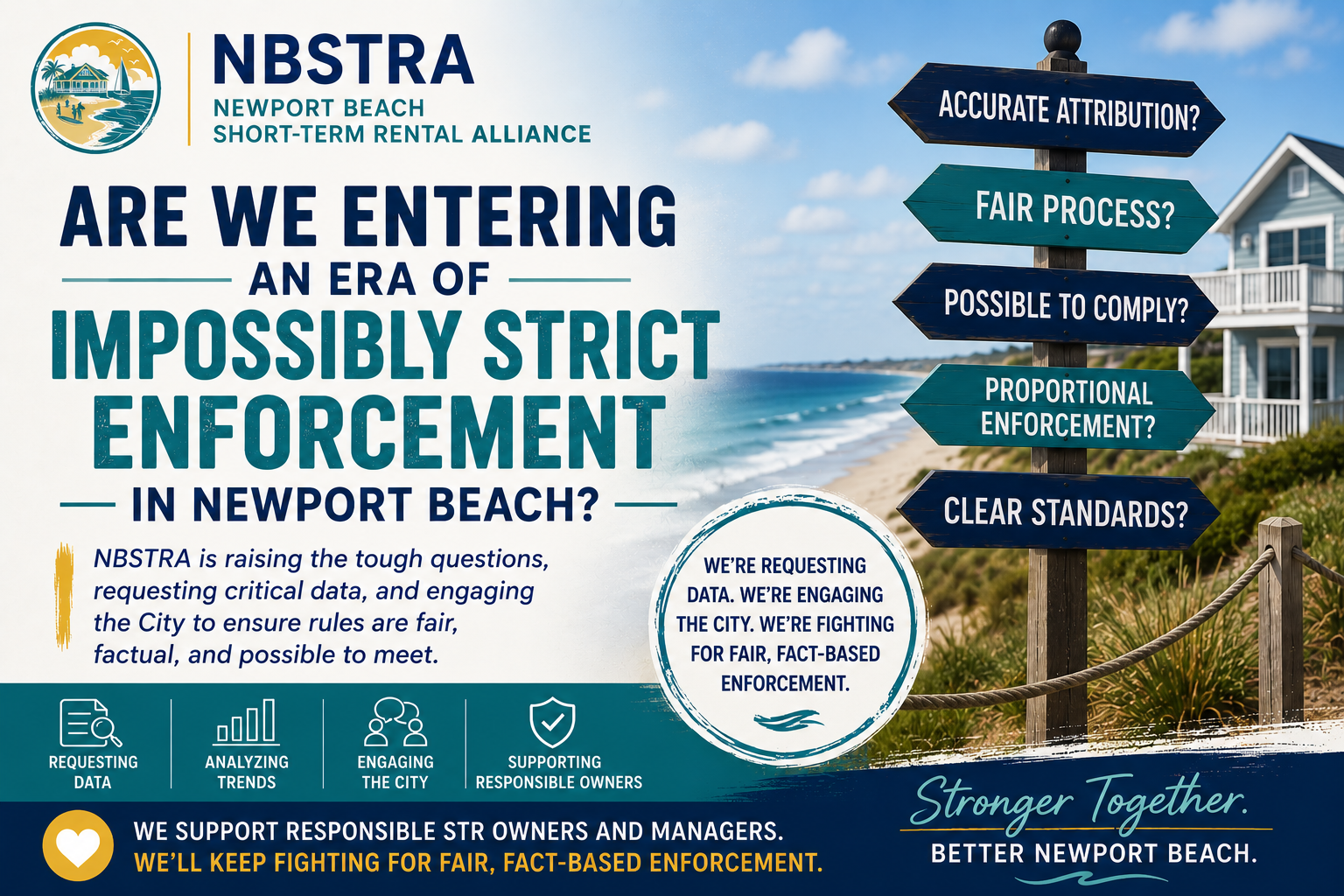
Is Newport Entering an Era of Aggressive Enforcement and Impossible Compliance?
NBSTRA supports responsible short-term rental ownership and management. We do not condone parking violations, excessive noise, disorderly conduct, or conduct that disrupts neighborhoods or creates public safety concerns.
Responsible STR owners and managers have a duty to screen guests, provide clear rules, maintain local contacts, respond quickly when problems occur, and operate in a way that respects neighbors and the broader Newport Beach community.
But responsible enforcement also has to be fair, accurate, transparent, and proportionate.
A recent case involving an NBSTRA member raises serious questions about whether Newport Beach is moving toward an enforcement standard that may be nearly impossible for even responsible owners and managers to satisfy.
The case involves a duplex with two separate short-term lodging permits. The City suspended one of those permits for six months based on two alleged violations within a 12-month period. One was a parking/local contact citation. The other was a July 4 Loud or Unruly Gathering Ordinance (LUGO) notice and related noise/disturbance citation.
The City’s ordinance allows a short-term lodging permit to be suspended when there are two qualifying violations within a 12-month period that relate to the permitted unit. That makes accurate attribution essential, particularly when a property has two separate permitted units.
In this case, the parking citation was initially not clearly assigned to either unit. The City’s position was that the violation applied to both permits simultaneously.
The owner and property manager later provided information indicating that the vehicle involved in the parking issue was associated with the other separately permitted unit, not the unit whose permit was ultimately suspended. Despite that, the City counted the parking citation against both permits.
That is a serious concern. If the City is going to impose the extraordinary penalty of suspending an STR permit, it should be able to clearly show that the violations actually apply to that specific permit.
The July 4 incident raises a different but equally important question.
The police report says officers tied the disturbance to the unit whose permit was later suspended, including statements from occupants of the other unit. NBSTRA is not dismissing that record. We are not minimizing the seriousness of any actual disturbance. And we are not suggesting that STR owners or managers should be excused from taking reasonable steps to prevent bad behavior.
But the City’s enforcement theory appears to place owners and managers in an extremely difficult position.
Under the City’s laws and rules, owners are expected to use “best efforts” to prevent guests, occupants, or visitors from creating unreasonable noise, disorderly conduct, alcohol-related violations, or similar problems. That standard makes sense when applied reasonably. Owners should have written rules, guest screening, good-neighbor policies, local contacts, parking instructions, holiday controls, and clear expectations for guests.
The concern is what happens when the City uses a fast-moving police incident as a strike against an STR permit and later treats the existence of the incident itself as proof that the owner failed to use “best efforts.”
If the owner or manager did not know about the incident while it was happening, how exactly were they supposed to correct it in real time?
If officers acted on their own observations rather than a complaint to the STR hotline or local contact, how is the owner supposed to demonstrate that they would have responded appropriately if given the chance?
If the City can later say, in effect, “a disturbance occurred, therefore best efforts must have been inadequate,” then the standard starts to look less like a best-efforts standard and more like strict liability.
That should concern every responsible STR owner and manager in Newport Beach.
NBSTRA is also concerned about timing and proportionality.
The second incident occurred on July 4, 2025. The City did not issue its notice of intent to suspend the permit until over seven months later. This placed the suspension period directly in the summer high season, when the unit was already heavily booked at peak rates. Existing reservations had to be cancelled, creating substantial economic harm for the owner, disruption for guests, and reputational consequences for the property manager.
The owner of this permit is retired and relies on the income from their STR, especially during the summer season. That has now all been lost.
If the City believed the property presented an immediate public safety threat, it is fair to ask why it waited months to act. If it did not present an immediate public safety threat, it is fair to ask why the penalty was imposed in a way that caused maximum economic harm.
NBSTRA is also reviewing the City’s demands regarding cancellation of bookings, removal of advertisements, revenue information, and reinstatement after suspension. A six-month suspension should not become longer or more uncertain because reinstatement standards are unclear or because the City imposes requirements beyond what the ordinance actually authorizes.
This case raises broader questions that matter to all Newport Beach STR permit holders:
How does the City determine whether a violation is tied to one unit, another unit, or as appears in this case, the City took the position that the parking violation applied to all units simultaneously?
How does the City distinguish STR-related disturbances from general beach-area or visitor-related disturbances?
How often are LUGOs, DACs, parking citations, and other enforcement actions actually tied to STRs?
How often are STR citations appealed, and how often are appeals successful?
How many STR permits have been suspended or revoked, and for what kinds of violations?
How does the City decide when to seek suspension rather than a lesser enforcement response?
What exactly must an owner or manager show to prove “best efforts”?
What are the standards for reinstatement after suspension?
These are not abstract questions. They determine whether responsible owners can operate with confidence, understand their obligations, and know how to protect their permits.
NBSTRA is taking action.
First, we are requesting the full public record related to this case, including the citations, police reports, dispatch records, communications, evidence used to assign the violations to a specific permit, and the City’s basis for its cancellation and reinstatement requirements.
Second, we are submitting a broader Public Records Act request seeking systemwide data on STR enforcement, LUGO notices, DACs, parking citations, STR hotline complaints, Safety Enhancement Zone enforcement, suspensions, revocations, appeals, and major holiday enforcement periods.
Third, we will be asking the City to explain how it distinguishes STR-related incidents from non-STR incidents, how it attributes violations to specific permits, and how owners and managers are expected to demonstrate compliance when enforcement occurs without real-time notice to the local contact.
Fourth, we will use the information we receive to advise members on practical compliance steps, including guest screening, parking documentation, local contact logs, holiday procedures, house rules, guest communications, and records that may be needed if a citation is later challenged.
Fifth, we will engage City officials to make sure enforcement is based on facts, applied consistently, and structured in a way that responsible owners and managers can actually comply with.
Newport Beach can enforce its rules without scapegoating STRs for every beach-area disturbance. The City can protect neighborhoods while still respecting due process and basic fairness. And responsible owners should not have to fear that one disputed parking citation and one fast-moving holiday enforcement incident can place an entire permit at risk months later.
NBSTRA will continue to support responsible short-term rental owners and managers. We will also continue to insist that the rules be clear, the process be fair, and the City’s enforcement standards be possible to meet.