
Coastal Commission Approves 120-Night STR Cap — A Warning for Newport Beach
While some of the worst provisions of Pacifica’s Law Were Watered Down, the Coastal Commission Action is Another Reminder That The Best Defense in Local Advocacy
A closely watched California Coastal Commission decision on short-term rentals in Pacifica should concern every Newport Beach STR owner.
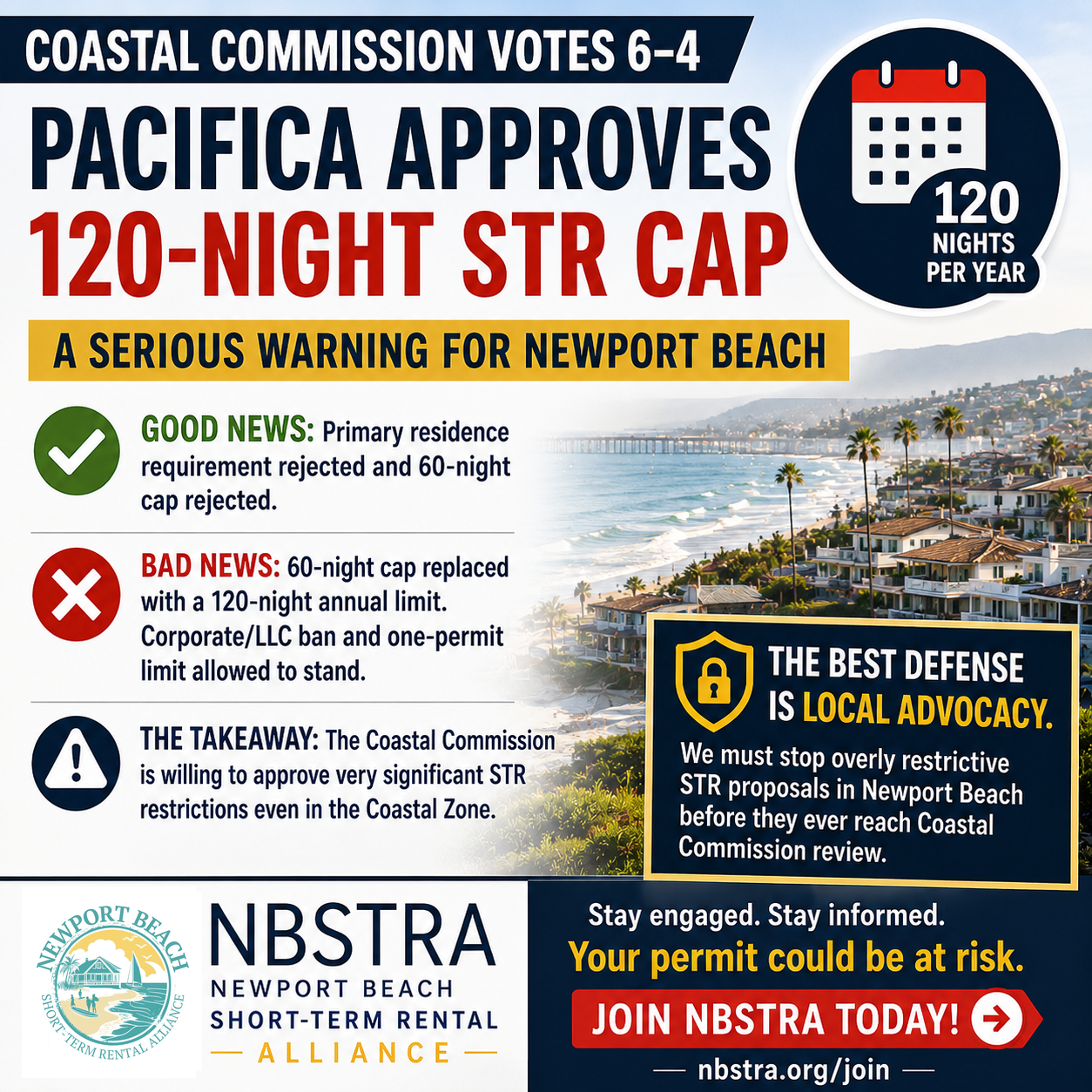
On August 12, the Coastal Commission voted 6–4 to approve Pacifica’s new STR regulations with significant modifications. The Commission rejected Pacifica’s requirement that an STR be an owner’s primary residence and rejected the City’s proposed 60-night annual cap on unhosted rentals.
That is the good news.
The bad news is that the Commission replaced the 60-night limit with a 120-night annual cap — despite Coastal Commission staff having recommended eliminating the nights cap altogether.
For Newport Beach, that is a serious warning.
The Coastal Commission Has Opened a Door
In addition to these changes, the Coastal Commission allowed Pacifica’s ban on corporate/LLC ownership of STRs to stand, and its restriction that people can only hold one permit. Both of these are very problematic for Newport Beach.
The Pacifica decision does not mean Newport Beach can automatically impose the same rules. Our Local Coastal Program, tourism economy, history of vacation rentals, and existing STR regulations are different.
But the decision does demonstrate something important: the Coastal Commission is willing to approve very significant restrictions on short-term rentals even in the Coastal Zone.
A 120-night cap would be devastating for many Newport Beach STR owners. For owners of duplexes who hold two permits, the single permit restriction would be equally bad.
The Pacifica restrictions apply regardless of whether a property has ever generated a complaint or violated a City rule. A responsible, fully compliant owner could effectively be prohibited from operating for roughly two-thirds of the year.
Until now, some may have assumed that a restriction that severe would have little chance of surviving Coastal Commission review.
After Pacifica, we cannot make that assumption.
Why Local Engagement Matters More Than Ever
The most important lesson from Pacifica is that we never want a proposal this restrictive to get far enough in Newport Beach that we are depending on the Coastal Commission to save us.
The fight has to be won locally.
That is especially important in the aftermath of the July 4 incidents on the Balboa Peninsula.
The facts increasingly showed that short-term rentals were not the driver of the violence, vandalism and disorder that occurred that weekend. The major problem was the large social-media-driven influx of teenagers and young adults into the area.
But that does not mean STR owners can become complacent.
There is always a constituency in Newport Beach that wants fewer vacation rentals. After a highly visible incident, STRs can also become an easy target even when they were not the cause of the underlying problem.
That creates a political risk we cannot ignore.
City leaders could face pressure from residents who already oppose STRs, combine that pressure with lingering concerns from July 4, and conclude that additional restrictions are politically attractive. We’ve already seen this from at least one Council Member. And after the Pacifica vote, they could reasonably believe that even a very restrictive proposal might have a pathway through the Coastal Commission.
That is precisely why NBSTRA must remain engaged now — before such proposals are written, before positions harden, and before a restrictive ordinance is sent for Coastal Commission review.
Enforcement Is Different From Punishing Responsible Owners
NBSTRA has consistently supported strong enforcement against genuinely problematic properties and operators.
But a 120-night cap is not targeted enforcement. It does nothing to distinguish between a property that repeatedly creates problems and one that operates responsibly year after year.
It simply limits everyone.
Newport Beach already has extensive STR regulation, including a citywide permit cap, occupancy and parking requirements, local-contact rules, enforcement provisions, and significant penalties for violations.
Our focus should remain on enforcing those rules and addressing actual bad behavior — not imposing arbitrary restrictions on responsible owners.
We Need to Stay Engaged
Pacifica is a mixed result.
The Coastal Commission rejected some of Pacifica’s harshest restrictions. But by approving a 120-night cap, it also showed that substantial new restrictions on STRs can win approval even in California’s Coastal Zone.
That makes NBSTRA’s local work more important, not less.
We need to continue making the case to Newport Beach policymakers that responsible vacation rentals are part of this community, contribute to our visitor economy, provide access to the coast, and should not be scapegoated for conduct they did not cause.
Our objective should be simple: never allow an unnecessarily restrictive STR ordinance to advance far enough that Newport Beach owners are forced to rely on the Coastal Commission as the last line of defense.
NBSTRA will continue monitoring developments in Pacifica and throughout California while staying actively engaged with the City to protect responsible short-term rental owners and managers here in Newport Beach.
And if you are reading this article and not yet a member of NBSTRA, what are you waiting for? Your permit could be at risk. Join us today!